In Focus
Svend-Allan Sørensen
& the Crow
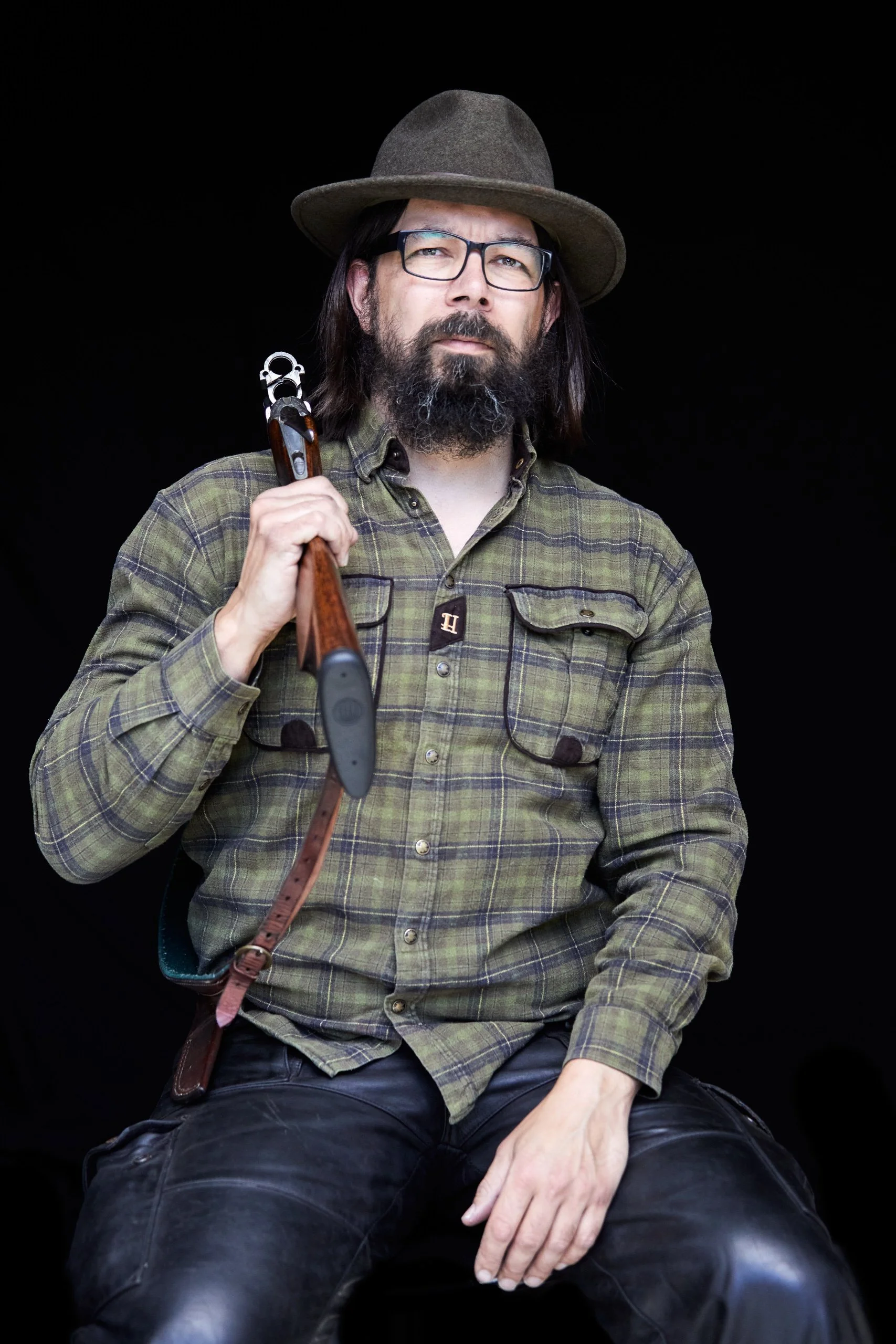
“I derive from a farm in Jutland. Today I am aware that this is also where my art derives from.
In recent years, my work increasingly reflects my rural upbringing, as if I drove backwards at full speed. My work is not street. My work is fields and woods.
It talks about what I grew up with and still care about. In this way, my work is contemporary.
At least my contemporary.I see my work as a long mumbling, visual beat poem. The literary inspiration is pervasive and several images consist only of short sentences that barely deal with the crow.
My fascination with this dark bird is often the starting point for my work. In order to make graphics work for me, it must have the character of a crow.In my work with graphics, I have used all sorts of knives and engraving tools as well as hunting weapons and stitches. For me, a knife, a nail, a hunting weapon are all rural tools that emphasize my artistic intention and my personal roots.
Printmaking, to me, is a contemporary medium: it is rooted in past traditions, and it moves into new territories of the future.
I like to think of my work as an extension of Danish artist Søren Hjorth Nielsen (1901-83)”.
Svend-Allan Sørensen
Photo by Rico Feldfoss
(Statement by Svend-Allan Sørensen from the artist’s website)
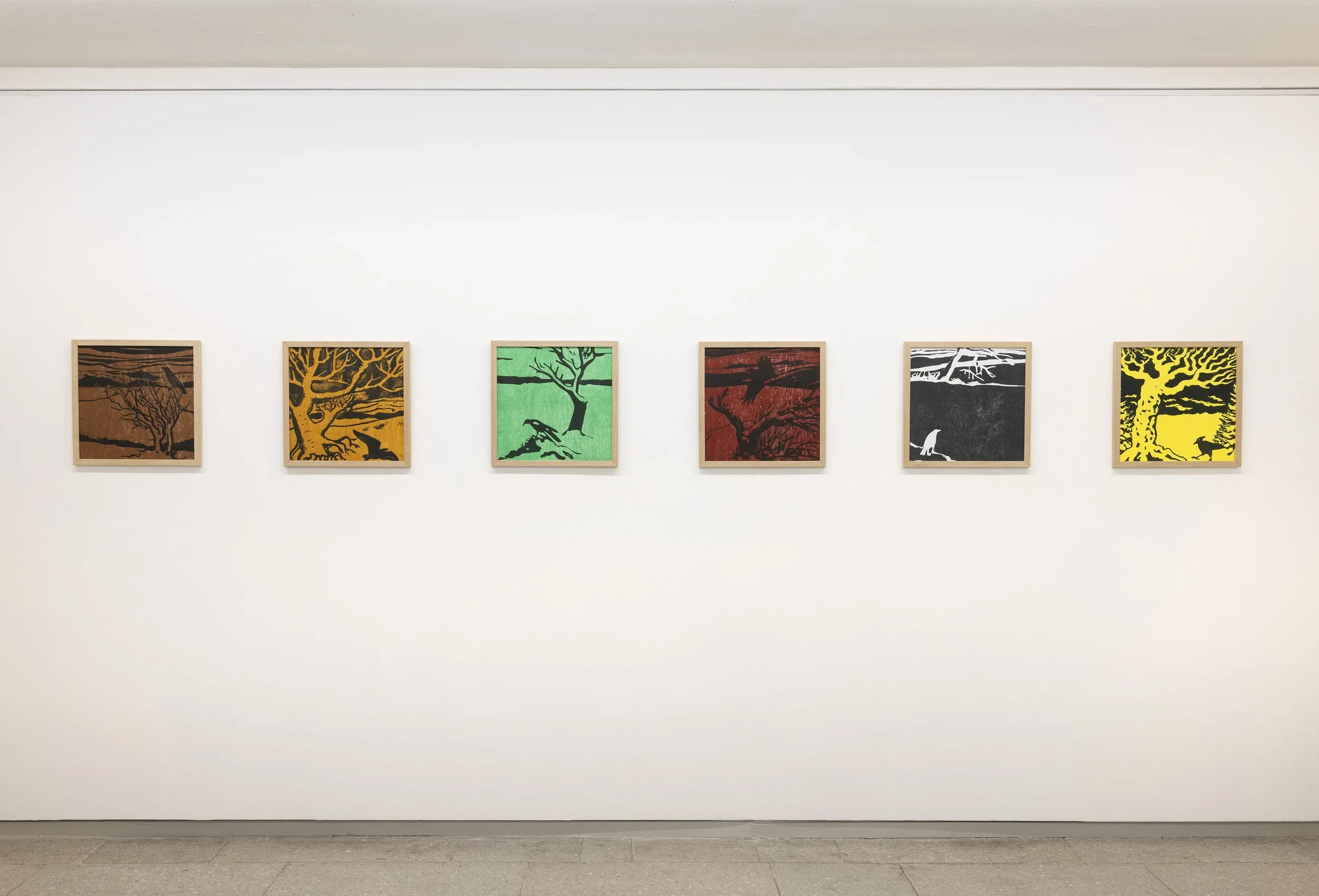
Installation view. Black Crows in the Meadow, solo exhibition, SPECTA, 2025
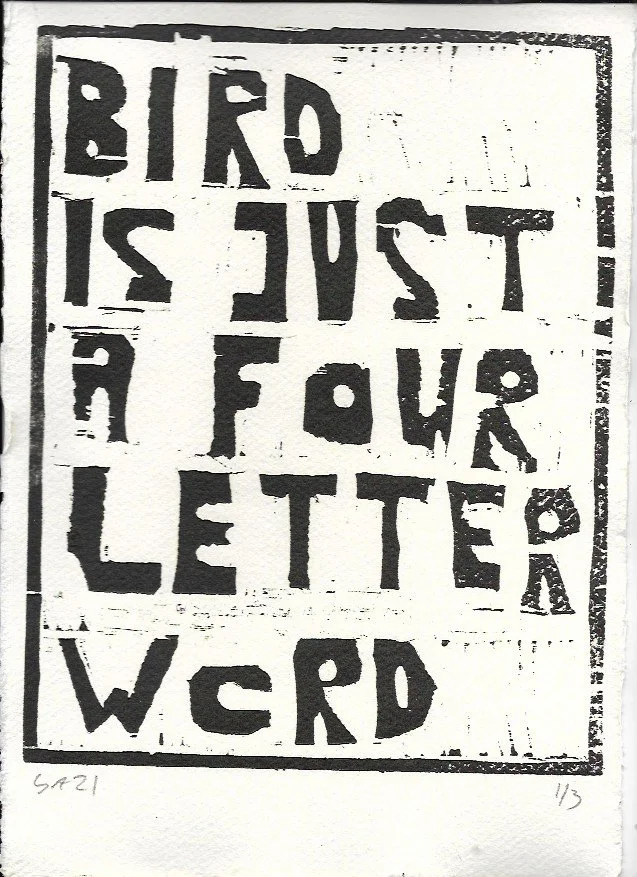
Kolonihavehustrykkene #1 / The Allotment-house-prints #1, 2021
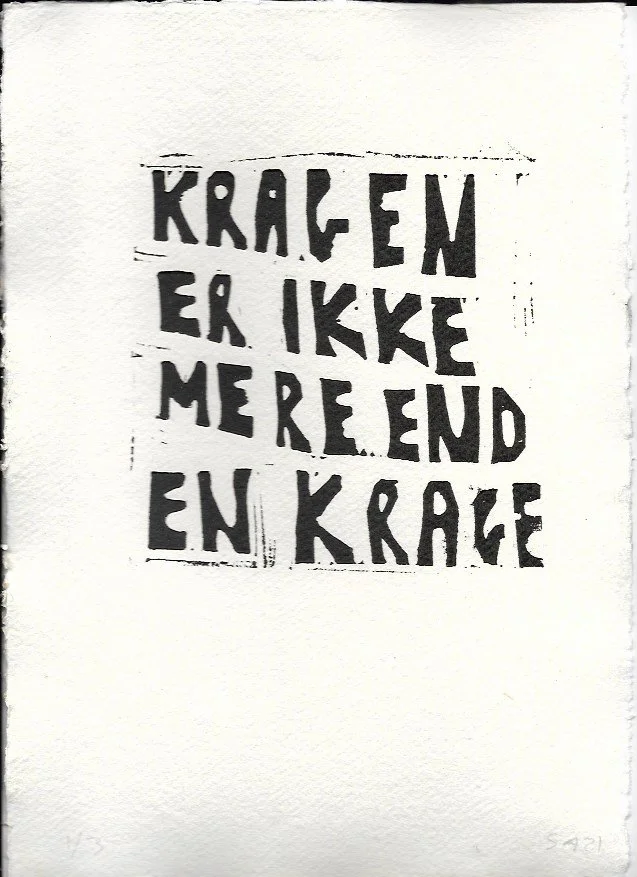
“The crow is no more than a crow”
Kolonihavehustrykkene #24 / The Allotment-house-prints #24, 2021
Svend-Allan Sørensen is an artist, hunter and poet whose work moves between the familiar and the unexpected. His artistic practice brings together nature, language, humour and a curiosity about the world around us.
Often beginning with something seemingly ordinary; a bird, a phrase, a song lyric or a curious thought, Sørensen transforms everyday observations into works that invite us to look beyond the obvious. A familiar sentence takes an unexpected turn, an animal becomes a political metaphor, and a playful image opens up questions that are not so easily answered. There is a certain pleasure in getting lost in his work: you might arrive looking for a bird and leave thinking about language, human behaviour or the contradictions of modern life. In this article, we take a closer look at Svend-Allan Sørensen’s artistic practice, exploring the works, ideas and methods that shape his distinctive approach to art.
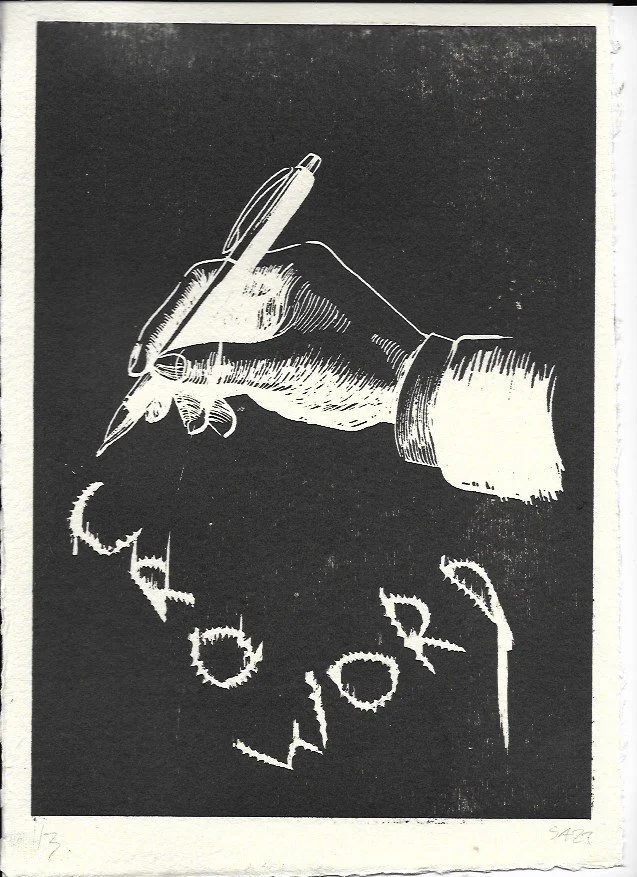
Kolonihavehustrykkene #142 / The Allotment-house-prints #142, 2022
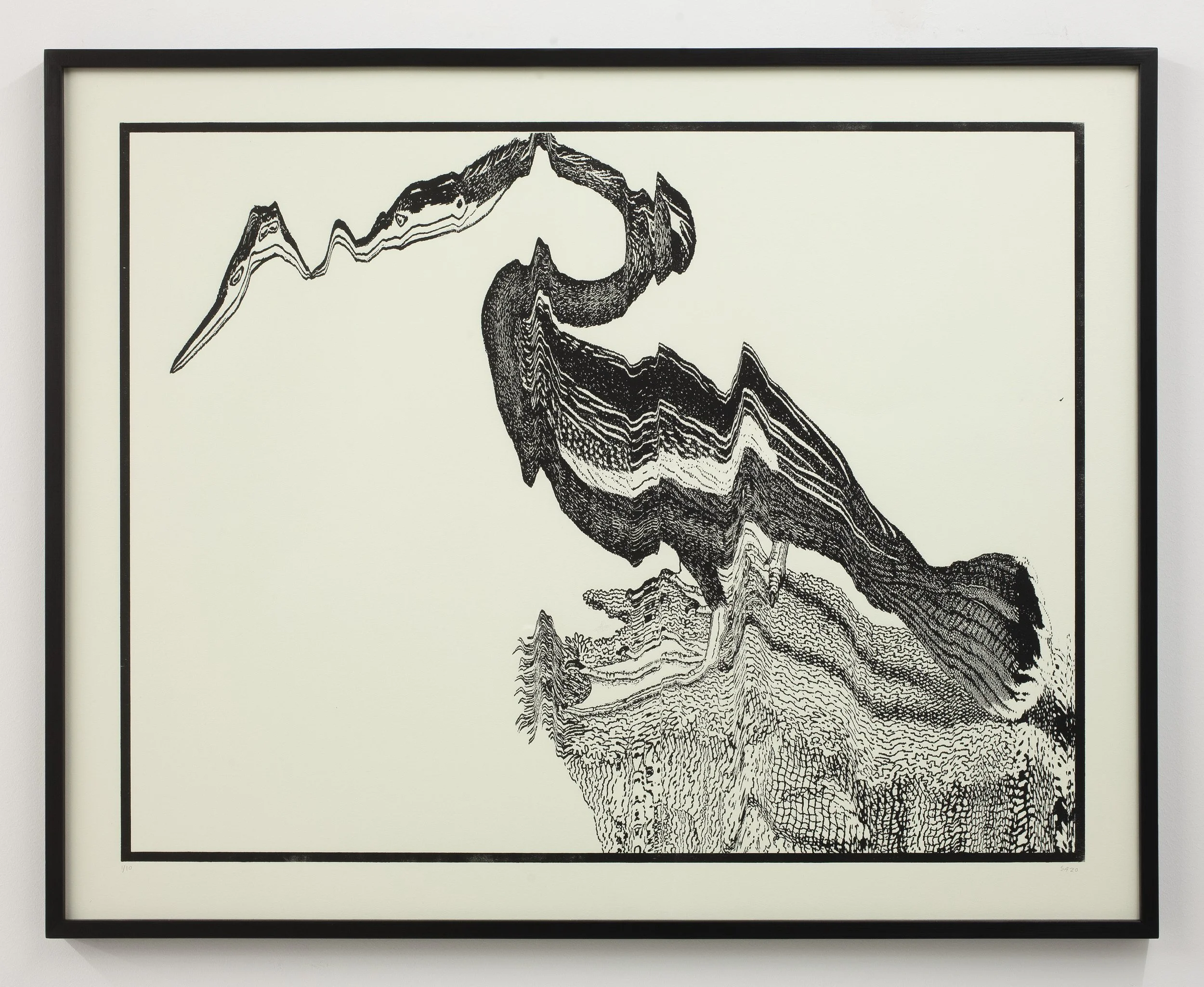
Birds occupy a central place in Sørensen’s artistic universe. Crows, blackbirds and other feathered creatures appear throughout his works, sometimes as recognisable animals and sometimes as characters in strange, humorous or thought-provoking visual statements. But a bird is rarely just a bird. It becomes a way into something else.
Sørensen uses birds as metaphors for human behaviour, social hierarchies, politics and power. Birds have their own territories, pecking orders and ways of asserting themselves, much like humans. At the same time, they inhabit a world that remains partly beyond our reach: they can take flight and disappear into the sky, possessing a freedom that we can only observe from the ground.
By looking at human concerns through the eyes of a crow, Sørensen creates room to approach serious questions without necessarily offering straightforward answers. His works encourage us to reconsider the connections between the natural world and human society, often revealing unexpected similarities between the two. Perhaps a bird can say something about us that we would rather not hear from another human being.
Language is equally important to Sørensen’s practice. He collects phrases, song lyrics, literary references and everyday expressions, discovering new possibilities by replacing a word, changing a context or allowing two meanings to collide. A familiar expression suddenly becomes strange, while a sentence that once seemed obvious begins to suggest something entirely different. The result can be funny, absurd, poetic or even a little uncomfortable.
His interest in language extends beyond clever wordplay. His texts explore how meaning is constructed, how words carry cultural associations and how a small change in wording can alter our understanding of an idea. Some phrases feel as though they have been overheard somewhere between a conversation, a song and a half-remembered thought. They invite us to pause, read again and make our own connections. Recognising every reference is not essential; sometimes the pleasure lies precisely in wondering where a sentence came from, or how on earth it ended up beside a bird.
Absurd Black Bellied Darter, 2020
Woodcut, 75 x 94 cm [62 x 81,5 cm]. Ed. 10
From the group exhibition Absurd Birds and Other Animals, SPECTA, 2021
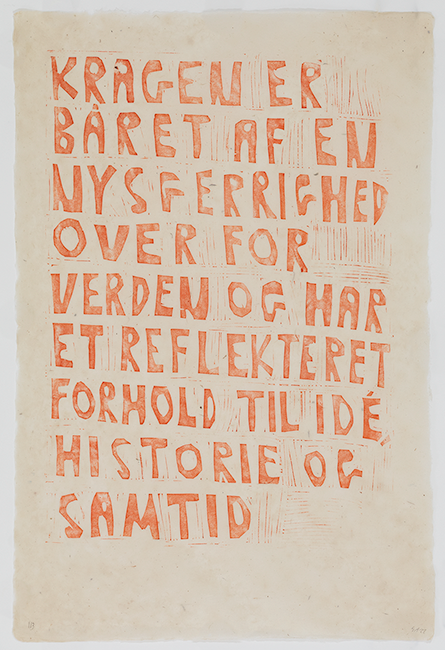
“The crow is driven by a curiosity about the world and maintains a reflective relationship with ideas, history, and the contemporary era.”
Kragens manifest #3 (The crow’s manifesto), lino cut,
ed. 3, 750 x 500 mm, 2022.
Photo: Per Johnsson, Atelje Larsen
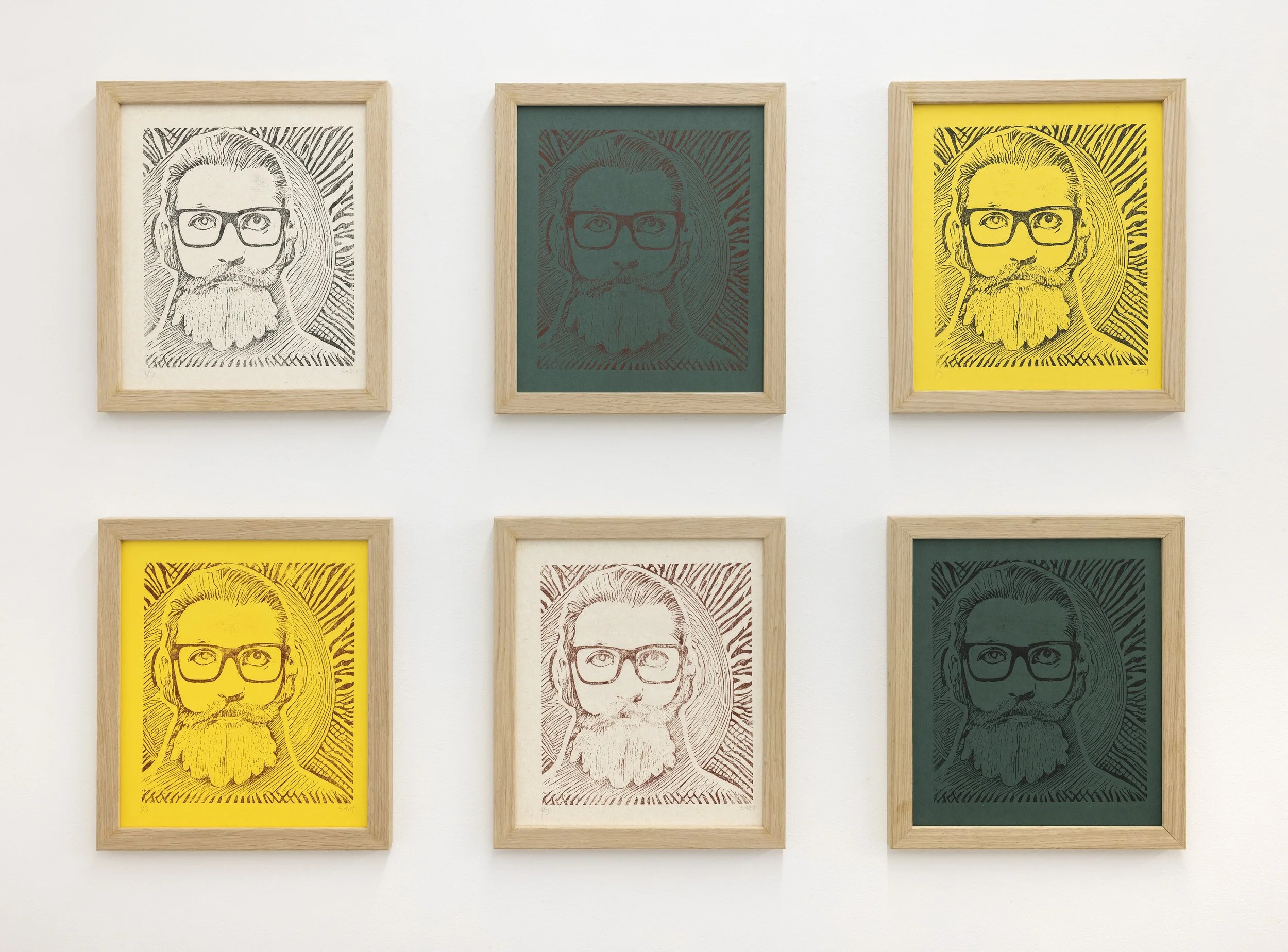
Middleaged Male Artist's Selfportrait. He Wears Glasses and Has A Beard. The Motif Is Made As A Woodcut no. 1-6, 2025
Woodcut, 28.5 x 24.5 cm. Ed. 3
Black Crows in the Meadow, installation view, SPECTA, 2025
This meeting of old and new raises an interesting question: what exactly is an original artwork when an image can pass through so many different hands, tools and technologies?
Is it the initial idea, the digital image, the wooden plate or the final print?
Sørensen does not need to settle the question. Instead, he uses the process itself as part of the work, allowing technology and craftsmanship to challenge one another. The result is an artistic practice that looks backwards and forwards at once, rather like driving full speed in reverse.
Other techniques Sørensen has worked with includes photography, heliography, lithography, etching, linocut, photopolymer gravure and drypoint.
Watch the video down below to get a deeper look into the traditional practice of creating graphic art. The video is a Queen Sonja Print Award Production.
Although Sørensen’s art often looks towards wildlife and forests, his artistic methods are not always straight-forwardly traditional.
Printmaking has been a recurring part of his practice, connecting his work to a long history of graphic art and the physical processes of cutting, carving and printing. At the same time, he embraces contemporary technologies, including artificial intelligence and digitally produced imagery.
In some more recent works, computer-generated images meet traditional woodcut techniques (see woodcuts above). A laser may cut a motif into a wooden plate, which is then used to produce a handmade print. The resulting image carries traces of several different processes, from digital generation to the physical act of printing.
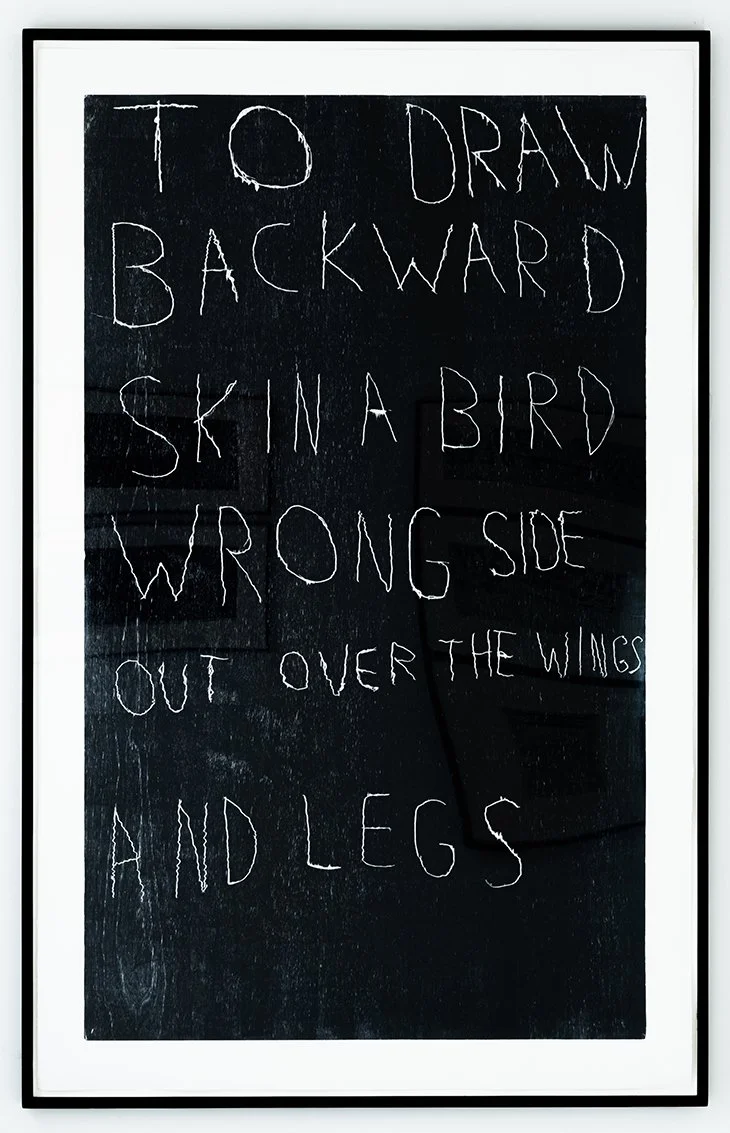
The final artwork from the video:
TO DRAW BACKWARD, woodcut, 235 x 140 cm, 2014
Photo: Rico Feldfoss
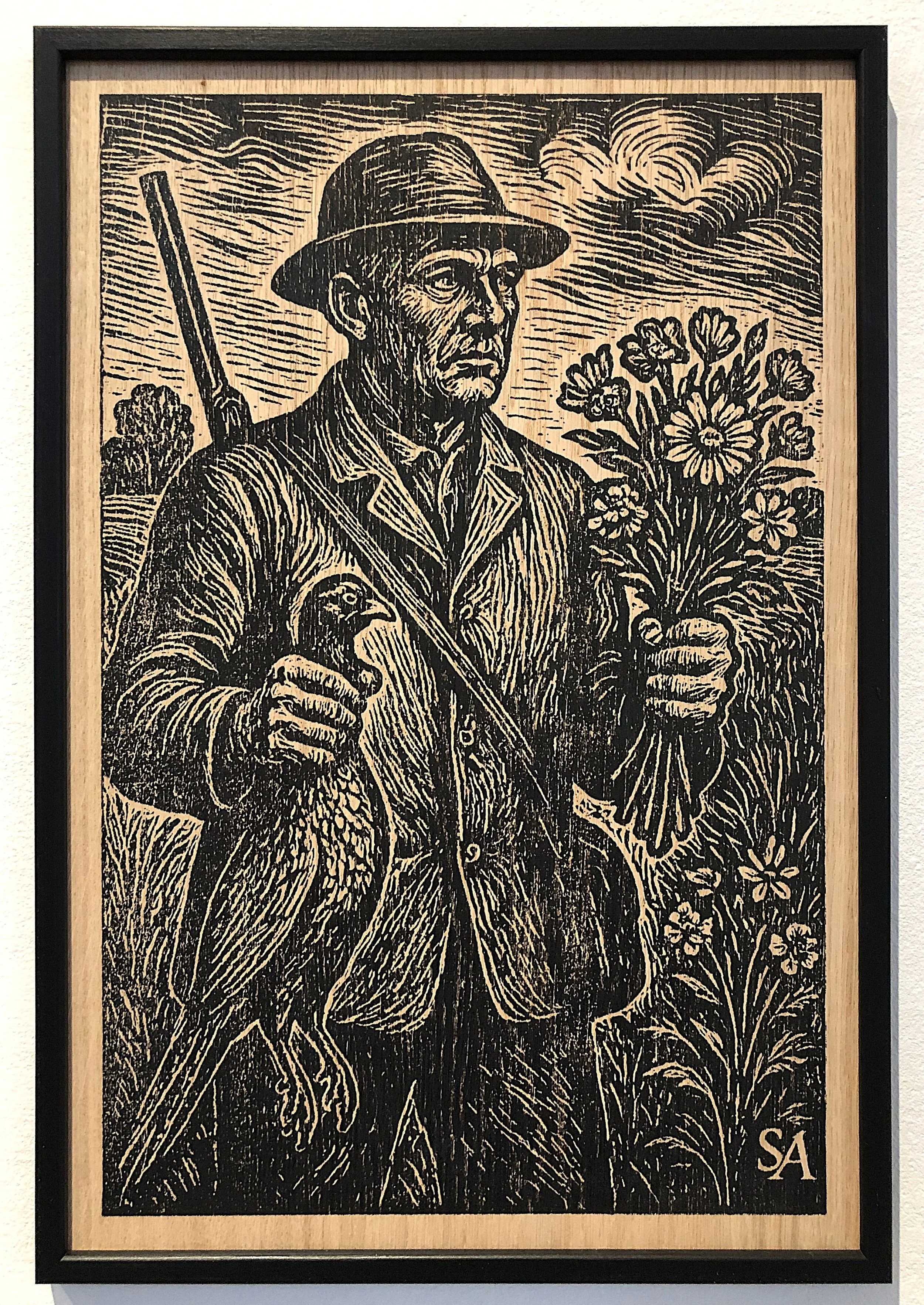
Jægeren går ud af skoven med geværet over skulderen som en gammel vane en gammel vej gennem kroppen han ikke gider forklare i den ene hånd hænger fasanen tung blank varm af aften og i den anden hånd en buket vilde blomster plukket uden plan fordi de stod der og ville med og han går langsomt som en mand der øver sig i at komme hjem igen…
The hunter emerges from the woods with the gun over his shoulder like an old habit an ancient path etched into his body that he has no desire to explain in one hand hangs a pheasant heavy glossy and warm from the evening and in the other a bouquet of wildflowers gathered without a plan simply because they were there and wanted to come along and he walks slowly like a man practicing the art of returning home...,
Woodcut on veneer, 2026
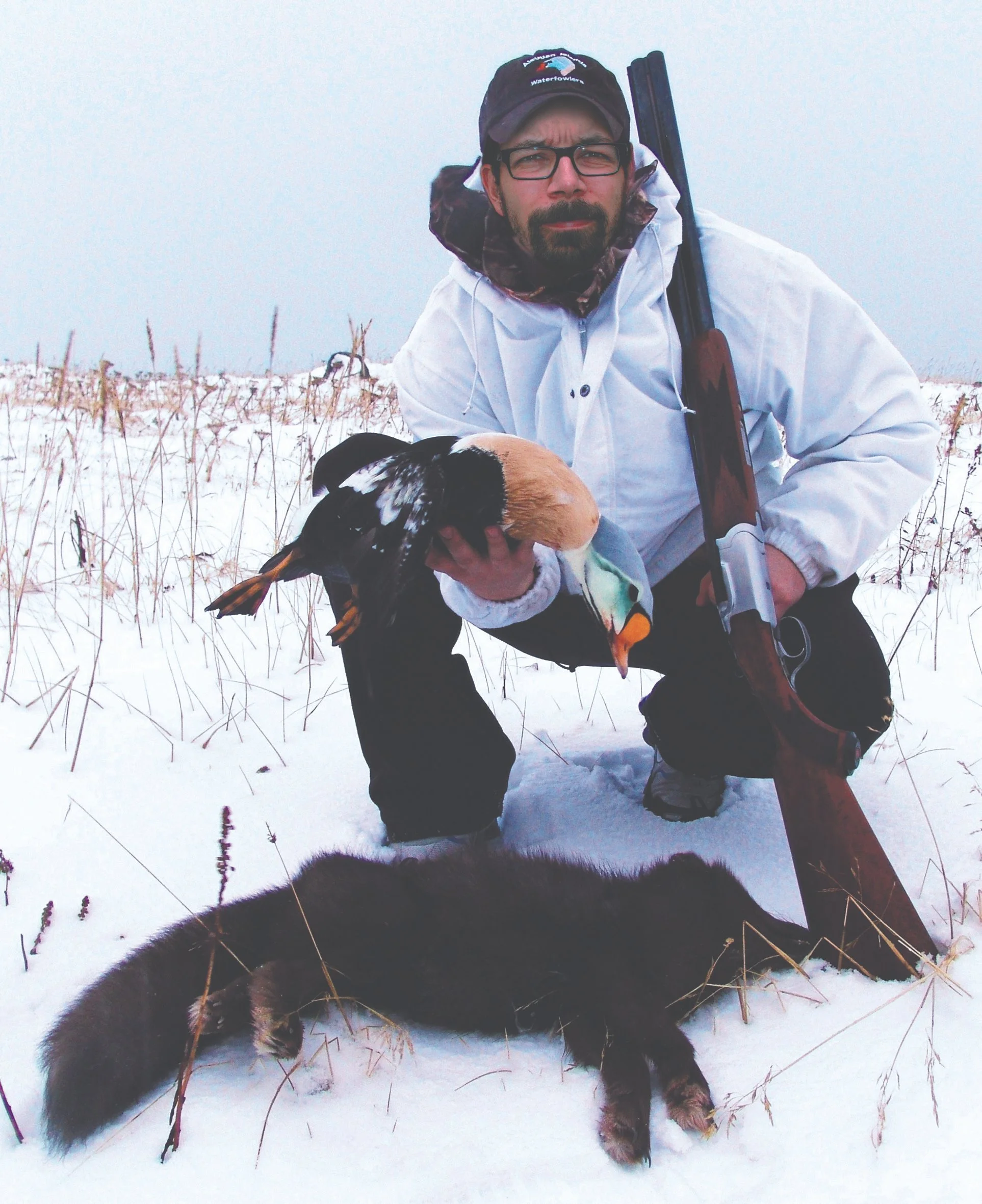
Photo by Jesper Olsen
For Sørensen, hunting is closely connected to his rural upbringing and his relationship with nature. Raised on a farm in central Jutland, he obtained his hunting licence at the age of seventeen. Hunting has since become a recurring subject in his art, reflecting a personal connection to the landscape and wildlife.
Sørensen’s relationship with hunting contains a certain tension. He has described it as something that is both beautiful and uncomfortable, bringing together a fascination with animals and the reality of killing them. This is also present in his artistic practice, where depictions of nature often extend into reflections on human behaviour and our relationship with the natural world.
Nature, culture and politics frequently intersect in Sørensen’s work. Birds, for instance, are not simply depicted as animals but can also suggest human hierarchies, territories and power structures. Through animals, colours and language, he creates connections between the natural world and human society, often approaching these subjects with humour and irony.
Sørensen’s close relationship with nature runs through every aspect of his artistic practice. Whether through a crow, a curious phrase or an unexpected combination of images and techniques, he invites us to look at the world from a slightly different perspective. His works are playful, poetic and full of surprising connections, reminding us that even the most familiar things can hold something unexpected.
For further insight into Sørensen’s artistic practice, we recommend exploring the interviews (in danish) below, which served as a great source of inspiration for this In Focus feature and offered a fascinating glimpse into the artist’s thoughts, inspirations and creative process:
“Jagtsæson!” - interviewed by Lisbeth Bonde
“Does Living with Birds Enhance My Life?” - interviewed by Lotte Boesen Toftgaard
Previous IN FOCUS presentations:
Ellen Hyllemose: Welcome to the Langerhans’ Islands
Isabel Berglund: Fluid Island of Pearls
Frances Goodman: Introducing - A new quilt series by Frances Goodman